Yacht Desalinators
EchoTec Watermaker Success
Versus
Sea Recovery Problems
A reliable desalinator will make your cruising in the South Pacific much easier and also much safer.
NOTE: Check out the La Vagabonde Sailing Video on how to install an Echo Tec watermaker.
NOTE January 2021 - Over TWELVE years of daily use and our ECHO Tec 500-BML watermaker from ECHO Tec desalinators for yachts is still working perfectly. We have run the desalinator in marinas, in muddy mangrove rivers, in harbours and at anchor. We are never in a marina and have not added any shore water to our tanks in many years. That's right, ALL our fresh water needs over the last 12 years have been met by our ECHO Tec watermaker. It has produced more than 600,000 litres of water. We generally run it just one hour a day and it's 80 liter an hour output meets all our water needs (including pressure water showers, washing dishes, clothes, dive gear, and even hosing off the deck once and awhile. Sheer joy. Other than backflushing with fresh water for two minutes after we run it and changing the pre-filters every week and changing the oil in the pump according to instructions, we have done practically nothing but turn it on and off when we run the engine. That's not to say nothing has gone wrong. We had a problem with the pressure gauge last February and one of the end plugs of the desalinator membrane housing developed a slight leak. The ECHO Tec support people were instantly available by email and they posted out replacement parts under warranty quickly. Fixing these glitches was quick and simple - the modular unit is so well engineered it is a dream to maintain and repair.
But on with the comparison between the dream and the nightmare. First of all:
Do you need a water maker aboard your cruising yacht?
Your health is THE most important thing you need to worry about when sailing far from civilized medical services. Drinking contaminated water is one of the most common ways cruising sailors get sick - and believe me, you can get extremely sick from water that is contaminated with a cocktail of viruses, bacteria, protozoa, microscopic nematodes, yeasts and fungi. You can never be sure if shore water is safe to drink - tap water might be fine for locals who have drunk the water since they were a baby, but that doesn't mean your system is ready for it.
As a research scientist on environmental problems in the Pacific Islands I learned all about island water supplies a very long time ago and the systems have, in many areas, degraded even more.
It's not just the biological contaminants you have to worry about either. My wife and I once got lead poisoning in PNG from drinking rain water from a catchment tank that had, years before, been "sealed" by painting the interior with a red lead paint. When we started cruising 40 years ago we relied on catching rainwater and purification filters - but in PNG there was a 4 month drought and the lead got through our filtration system. I nearly died from acute lead poisoning
How much water does a cruising yacht use?
My wife and I use between 20 and 30 liters of water a day for showers, washing dishes, cleaning, and rinsing. We use another 9 liters of water a day for drinking and cooking. The Moira's tanks hold about 400 liters of water which means that we would run out of water in 10 days - although we can stretch it to two weeks if we are careful.
Even during the rainy season in the tropics we used to have to find shore water somewhere about once a week or carry drums ashore to fill. This is a royal pain after a few years of continuous cruising and can be a serious problem if there isn't a handy source of potable water around.
Which is the best desalinator for a cruising yacht?
If you are thinking of buying a watermaker our recommendation is to get an ECHO Tec unit. ECHO Tec watermakers are designed and built for cruising yachts. ECHO Tec is a yacht-friendly company based in Trinidad. Their desalinators cost half as much as the big name Superyacht brands.
I bought the ECHO Tec 500-BML-1 unit with a low pressure gauge, maintenance kit, extended maintenance kit, boost pump and dual prefilters and had it shipped to New Caledonia for half the price that I paid for a Sea Recovery Ultra Whisper a couple of years before we got the ECHO Tec(more about that mistake later).
We installed our ECHO Tec watermaker ourselves aboard our 44' cutter Moira. It was easy to set up and when we turned it on, I was (and am still) astonished by the stream of water it puts out. It is "rated" to put out 20 Gallons (76Lt) per hour but in fact it gushes out 31 gallons (120 liters) an hour. Every other watermaker I have heard about invariably puts out less than factory specs - especially after it has been in use for a long time.
The ECHO Tec desalinator has been easy to maintain. In fact, we've done nothing at all but use it and change the prefilters since we installed it. We use it every day and it has kept our tanks brim full since day one of operation. With our normal water use, we run it less than an hour every day.
About Yacht Watermakers
Desalination of seawater using reverse osmosis membranes became a reality in 1959 when a team of researchers at UCLA made a breakthrough in cellulose acetate polymer membranes. The first commercial reverse osmosis plant began operation in 1965 in the California town of Coalinga. By the mid 1970's, when Freddy and I began our cruise of the Pacific, boat sized desalination units were just appearing on the market. But they were a nightmare of plumbing and power problems - after all, in order to desalinate seawater you need to create a constant flow of seawater through the membrane element at between 40–70 bar (600–1000 psi).
The Power Survivor Watermaker
In the late 1980's a small company in Canada began making a little 12 volt desalinator called the Power Survivor. It was the first desalinator I had seen that was engineered as a single, integrated unit to desalinate water. It only made about 4 liters an hour but that was enough to keep us in drinking water. I bought one immediately and used it for more than a decade, changing the membrane unit every 2 or 3 years (we found that staying in a marina and pickling the membrane invariably shortened the life of the membrane).
Unfortunately, Pur bought the Power Survivor technology. They did a re-design which looked good on paper. I bought one and the new "updated" unit worked about 2 months before it began to have serious problems. We found the Australian service center for Pur to be hopeless. We continued using the old Power Survivor while trying in vain to get the new one repaired.
Pur sold the technology to the Katadyn water purification company. Katadyn service and support was so poor we decided the era of the wonderful Power Survivor had ended - at least for us. Anyway it would be nice to have more output and after our experiences with the Pur technology and Katadyn's "service" it was not going to be one of their larger units.
Sea Recovery Watermaker Problems
I did a great deal of research - but alas not enough. I missed a 2001 post in www.sailnet.com that read "Avoid SEA RECOVERY like the plague. Send me an email if you want a list of problems - too long to list on BB." Oh how I wish I had seen that posting before I dropped AUD$12,000 on a Sea Recovery Ultra Whisper modular unit.
The dealer in Australia had just switched to Sea Recovery after having a series of problems with Spectra watermakers. His showroom model looked fantastic so we ordered one. When we started to install it our problems began. The installation and service book that came with the unit was the most confusing document I have seen in a long time - for example, the high pressure pump described in the handbook wasn't even the correct model. Eventually, after nearly 10 days, and with the able assistance of the dealer in Australia, we got it set up and turned it on.
The Sea Recovery Whisper 400 is a 12 volt "energy saving" desalinator. To paraphrase that 2001 post I mentioned earlier, Avoid energy saving 12 volt desalinators like the plague.
It worked fine when we first ran it, although it did not put out as much as it was rated for. So we sailed off to New Caledonia and Vanuatu with our high tec water maker. After three months of cruising the output gradually fell off to a pathetic trickle. Mysteriously sometimes it would put out almost half of it's rated capacity and then the next day, for no obvious reason, it trickled out less than our old power survivor.
The unit was still under warranty but we were in New Caledonia on our way to Vanuatu so we could not call the Aussie dealer and tell him to come by for a look. The Sea Recovery Dealer in New Caledonia - Alto marine - told us that since they didn't sell the unit they were not obliged to help us get it fixed. I sent emails to the Australian dealer who sold it to us with copies to Sea Recovery in California asking what they thought was wrong. I finally got a reply from Sea Recovery and they diagnosed the problem as a faulty feed pressure pump head. They sent a replacement under warranty (I had to return the faulty one).
That didn't fix it. So they decided the seals in the Energy Transfer Device needed to be replaced.
When the new Oring seals and valve kit arrived, Sea Recovery had valued it for Customs at US$410 - and I had to pay 40% customs tax on that which was, I thought, pretty expensive for a package of seals. I managed to get the new seals in place without too much trouble but as I replaced them I began to realize there was a major flaw in the concept of "energy saving" devices that relied on two double-ended pistons moving back and forth inside a cylinder with high pressure sea water. There are 11 sliding seals and 26 o-rings in the Sea Recovery Energy Transfer Device. The sliding seals are a special plastic but they wear as they slide back and forth in the stainless housing trying to build up the required 600psi to squeeze fresh water through the reverse osmosis membrane. At US$410 a pop plus a day's effort to disconnect, dismount, take apart, reassemble, remount, reconnect the unit (which is really heavy, by the way) this is a major problem if it needed to be done once a year. Replacing them every couple of months would be- and turned out to be - a nightmare.
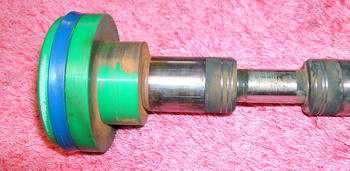
Sea recovery high pressure piston at 120 days of use.
The new seals began to wear out after another 60 days - but meanwhile another problem popped up. At the ends of the two lower cylinder housings for the Sea Recovery Energy Transfer Device there are two stainless plugs. They serve no obvious purpose. One of them developed a pin-hole leak through the threads. This sprayed atomized sea water throughout our engine room.
Out comes the Energy Transfer Device, take it apart, remove the leaking plug, and screw it back with the very hardest high pressure thread compound we could find. I noted that the plug was not "pipe thread" that could be expected to seal OK under pressure and there were very few threads to hold back the pressurized sea water and the plug wasn't even a very good fit. Such a tiny bit of inconsiderate engineering for such a complex and expensive bit of gear. Anyway, got it back in place, waited 48hrs to be sure the thread compound was fully hardened, fired it up and hey - it leaked again. I repeated the process with another brand of high pressure sealant and this time it sealed OK. in another two weeks the plug on the other end let go. I suppose I should have anticipated that. Disconnect (that means removing 4 high pressure connectors and sponging up the sea water that goes everywhere), Dismount (remove the 4 mounting bolts, heft it down and out of the engine room), remove the plug, redo the bedding compound, let it sit for 48 hrs to assure complete cure, remount, reconnect.
The mini-inconsiderate-engineering-stupidities of Sea Recovery engineering extend even further. On a weekly basis we changed our two prefilters. This simple changing of two filter cartridges was a major effort. The filter housings have a raised ridge with rounded plastic tabs on them so you can unscrew them. Good luck. Their engineers somehow managed to design and build the filter housings so they screw in and jam. Getting them to unscrew was a violent struggle. I bought steel strap and rubber strap and jawed filter removers. Finally I resorted to using a big screwdriver placed against the ribbed part of the housing and tapping it loose with a hammer.
After a year (and another set of seals and orings) we again had sea water atomizing in the engine room. This time it was a pinhole leak in one of the very small elbows on the Energy Transfer Device. Before trying to repair it, I needed some replacements. In December I sent an email to the woman in charge of parts for Sea Recovery asking for replacements. No reply. However it was the cyclone season in New Caledonia and we were in the marina - the desalinator was in storage mode. Sometime in February I realized I had not had a reply so I sent another email. No reply. In June, when we were ready to fire up the desalinator again I wrote emails to everyone in Sea Recovery plus the Australian dealer explaining that my $12,000 desalinator was sitting idyll because of a little elbow fitting. I had tried to find a replacement myself without success. The shot-gun spread of emails found its mark and in another 30 days a package arrived with 4 replacement elbows. Right, by now it was a routine, disconnect, dismount, remove the faulty elbow. Oops. When trying to take the elbow out it broke off flush with the Sea Recovery Energy Transfer Device unit. The reason it broke off was because the elbow was chrome plated brass screwed into the stainless housing. Electrolysis had turned it into a sponge. Next, get a screw extractor and try to remove the rotten brass without hurting the threads in the housing itself. This only took a few hours. When I opened the bag with the replacement fittings I was astounded, really amazed, to find that the replacement elbows were not only salvaged from an old unit but whoever took them out damaged the threads so they were useless! And they were also plated brass. I used the least damaged one to replace the one that had leaked and sent off some blistering emails to Sea Recovery about sending crap replacements of such a cheap but vital part.
And so the story goes. I finally got replacement fittings and went through the process of replacing them (yes, the others also broke off when I tried to remove them). At the end of the cruising season my Sea Recovery watermaker was barely trickling out water again. We also had to replace our steering cables because of their repeated exposure to the salt water from the desalinator.
I hated to admit it but I had thrown away $12,000 when I bought the Sea Recovery watermaker. I doubted it would ever work properly. All the safety and automated product water testing features were screwing up. The electric relays for the feed motor had blown and were replaced. The membrane salt detection system was cleaned twice (not easy either) and I finally simply disconnected it. I started looking for a replacement desalinator.
ECHOTec Watermakers comes to the Rescue
ECHOTec had very good online reviews with satisfied customers. The more I saw, the better I liked their unit. I also liked their reasonable prices. I ordered one and ECHOTec shipped it to me in Noumea. I unpacked the crate on a Tuesday. I got the model that mounts on the front of the engine and is belt driven. I had to get a new pulley turned to fit on the motor and that took a couple of days - during which time I installed the rest of the modules. Unlike the Sea Recovery experience, installing the ECHOTec was a breeze. It actually took me longer to remove the Sea Recovery modules than it did to install the ECHOTec. The ECHOTec uses "standard" fittings, not special made-to-order-impossible-to-find parts. I was ecstatic that the prefilter housings were clear (so I could see when the filter needed changing) and Sooooo easy to change the filter. Silly as it sounds that little comparison between the ECHOTec and the Sea Recovery watermaker was enough to really delight me. When the engine pulley was ready I bolted it on, connected it all up and fired up the diesel. WOW. Product water came out in a really healthy stream and within 30 seconds tasted perfect.
Update 2010
After two years of every day use I have come to love my ECHOTec watermaker. Simple, efficient, powerful, perfect.
Every time I start it up I remember watching the high pressure gauge of the "energy saving" Sea Recovery unit struggling to make 500 psi. With my ECHOTec the pressure comes right up to 800psi as I slowly screw in the pressure regulator valve.
Don't let anyone sell you on the idea of an "energy saving" 12 volt system. We have to run our diesel to make enough juice to operate the watermaker anyway so why worry about a big, expensive, complex energy saving unit when you are going to run the engine anyway?
We now enjoy more water than we need and a trouble free system that is a pleasure to maintain.
Update 2012
Our ECHOTec watermaker is still working perfectly. I really love it.
Update 2016
Amazing how fast the time goes by - here it is eight years after installation and it is still working perfectly - every day - everywhere we go.