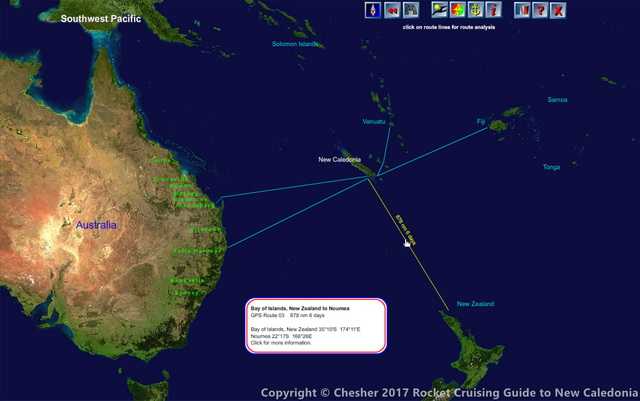
Sailing or motoring to New Caledonia is an enjoyable experience so long as you pick the correct weather window and the vessel is seaworthy.
Picking the weather is easier than ever these days with long range weather forecasts and satellite imagery. But there is a knack to doing it.
My wife, Frederique and I have made these passages over the past 30 years we have been annually migrating between the Pacific Islands aboard the Moira. Not to press our luck, I can say 90% of our passages have been relaxing, and pleasant. The methods we use are described in full detail on the CD-ROM cruising guide to Vanuatu and on the cruising guide to New Caledonia along with time-lapse images, month by month, of the weather patterns in the south Pacific. On the guides you will find complete details on ocean passages, where to leave from and when to go.
If you want to make "magic" passages get our cruising guides and go over the instructions. But meanwhile, here are some tips on how to make an easy and happy passage.
1. Don't leave until the weather window is right. This means getting ready to go well in advance of the expiration of visas or customs requirements and then being prepared to wait (as in ready to go today). Getting ready to go also means going to the place you wish to leave from (see below for suggestions on departure ports).
2. When you are ready and in position, start watching the weather by going to two or more of the long range marine weather forecast sites. There are 4 main models available, NOAA and the US Navy in America, IGES in Canada, and the European Model (UK Online Sailing Weather). Each of these give 5 day forecasts or more.
3. The US Navy weather links for the GFS (Global Forecasting System) and NOGAPS are especially useful because the map format is the same for both of these two major computer models. In addition you can now directly compare the maps from both models from any of the maps.
Click on the US NAVY Aus/NZ area - NOGAPS Model (You can compare maps from both global models from each day's map page) and select the "all" link next to the "Previous 12-hr Precipitation Rate [mm/12hr] and Sea Level Pressure [hPa]" table cell.
This will download a series of sea surface pressure and precipitation maps for up to 180 hours in the future. Once all the maps are downloaded you can see what the NOGAPS model is predicting day by day for 7 days. To compare this with the Global Forecasting Model click on the compare GFS Oceania link in the upper left hand corner of the screen. This will give you a second forecast for the same time period. You should examine the comparison at different time intervals - like 3, 5 and 7 days in the future. They will probably diverge to some degree with time. If there are major differences between the models, the weather is uncertain - don't go.
Save these two sets of maps so you can refer to them again.
4. After three days, download the same set of maps from the same sites. Now you can compare what each model said the weather picture would be on the third day (from the maps you saved earlier) with what the maps look like after the prediction period has elapsed. If the predicted maps match the actual maps - the weather is predictable. If there are significant differences between the maps the weather is unpredictable - don't go.
5. Do this again after 3 more days. Now you will have an idea if the weather is predictable or not and which weather model is doing the best job of getting it right.
6. Watch for a 7 day prediction that offers winds from a favorable direction (you can go a long way in 7 days with the right winds). One model will be doing better than the others, but the other models should be close. Again, if the models give a significantly different set of maps with major differences in where the the winds will be coming from - don't go.
7. When you see the right wind pattern for your trip and both models essentially agree - go immediately. Go as soon as you see the favourable winds on both models - even if you have only been watching the weather for 3 days. (We have gone immediately on the first day of watching the weather when the winds were looking good and both models agreed - but that does not happen often). |